Worst in the League? Jake Elliott’s Misses Put Eagles’ Kicking Game Under the Microscope
A Growing Concern as the Playoffs Approach
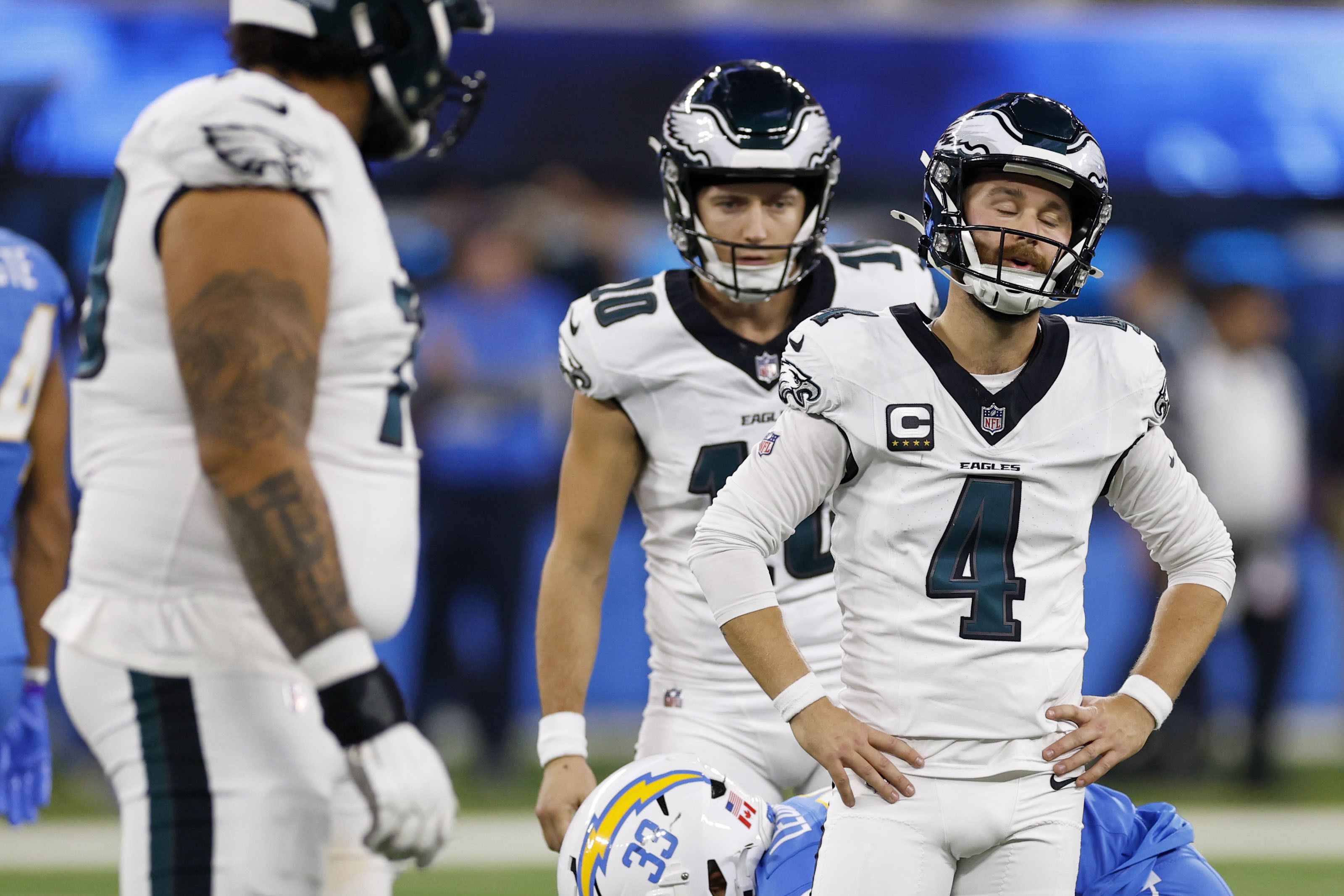
The Philadelphia Eagles are heading to the playoffs for the fifth straight year, a remarkable achievement that speaks to the organization’s overall stability and talent. Yet beneath the surface of another successful regular season lies a troubling issue that refuses to go away: the sudden and sustained decline of kicker Jake Elliott.
Once considered one of the most reliable kickers in the NFL—and a Super Bowl hero no less—Elliott now finds himself at the center of uncomfortable conversations. As the postseason looms, the Eagles face a difficult question they never expected to ask: can they still trust their kicker when it matters most?
From Automatic to Uncertain
For much of his career, Jake Elliott was synonymous with dependability. Inside 50 yards, he was nearly automatic, routinely converting kicks that fans barely reacted to anymore. That sense of calm has vanished.
Over his last nine games, Elliott has missed seven field goal attempts, going just 11-for-18 during that span. More alarming than the raw numbers is the nature of the misses. These are not desperate, end-of-half heaves in brutal conditions. These are routine kicks—41 yards, 43 yards, 48 yards—the type an NFL kicker is expected to make consistently.
Before this season, Elliott converted 92 percent of his field goals inside 50 yards. This year, that number has dropped to 81 percent, well below the league average of 91 percent. For a playoff contender, that gap is massive.
Historically Bad Territory
Statistics place Elliott’s recent stretch in uncomfortable historical company. He is now the first Eagles kicker since 1997 to miss seven field goals over a nine-game span. His accuracy rate since Week 7—just 61.1 percent—is the worst by an Eagles kicker in a comparable stretch since the early 1990s.
Those are not names or eras Eagles fans want to revisit. Kicking instability has derailed promising seasons before, and history suggests that ignoring the problem rarely ends well.
When Confidence Disappears
Perhaps the most telling sign of Elliott’s struggles isn’t found in the box score—it’s found on the sideline. In a recent game, head coach Nick Sirianni chose to go for it on fourth-and-7 rather than attempt a 56-yard field goal that would have tied the game.
That decision spoke volumes. Elliott was once elite from long range, converting 8 of 9 kicks from 56 yards and beyond in his first seven seasons. Over the last two years, he is just 2-for-8 from that distance. When a coaching staff no longer trusts its kicker in moments he used to own, something fundamental has shifted.
Trust, once broken, is hard to rebuild—especially under playoff pressure.
Elliott’s Perspective: Frustration and Accountability
After his most recent rough outing, Elliott did not deflect blame. He described the performance as “frustrating,” noting that he felt strong during pre-game warmups and believed at least one miss was affected by wind.
His comments reflected a veteran aware of the situation but still confident in his process. That confidence, however, must eventually translate to results. In the NFL, explanations matter far less than conversions.
Kickers often describe their job as mental as much as physical. Once doubt creeps in, it can snowball quickly. Each miss becomes heavier than the last, especially when the entire stadium feels it.
Why This Matters More in January
In the playoffs, margins are razor-thin. Games between elite teams are often decided by a single score, a single possession, or a single kick. A missed field goal can swing momentum, field position, and belief.
The Eagles have enough talent on both sides of the ball to contend with anyone. Their defense remains a strength, and the offense, while inconsistent, is capable of explosive moments. But none of that matters if scoring opportunities go unfinished.
A shaky kicking game doesn’t just cost points—it changes how games are called. Coaches become more aggressive or conservative in the wrong moments, drives stall under pressure, and opponents gain confidence.
Do the Eagles Ride It Out?
The central dilemma is timing. Jake Elliott’s résumé is strong. He has delivered in the biggest moments, including a Super Bowl run that still defines his career. Cutting or benching a veteran kicker weeks before the playoffs is an extreme move, one that can backfire.
At the same time, pretending the problem will fix itself is risky. Hope is not a strategy, especially when the data shows a sustained decline rather than a short slump.
One possible middle ground is bringing in competition—signing another kicker to the practice squad to apply pressure and provide an emergency option. It’s not an indictment, but it is insurance.
Loyalty vs. Reality
NFL teams constantly walk the line between loyalty and results. Elliott has earned respect, but respect alone doesn’t win playoff games. If the Eagles believe his struggles are mechanical or mental—and fixable—they may choose to stand by him and trust his experience.
If, however, they believe the decline is real and ongoing, the cost of inaction could be devastating.
This is not about erasing Elliott’s legacy. It’s about confronting the present.
The Clock Is Ticking
With only a few regular-season games remaining, the Eagles don’t have the luxury of time. Every missed kick adds urgency to the conversation, every hesitant coaching decision magnifies the concern.
Jake Elliott’s story is now one of the most important subplots of Philadelphia’s playoff push. Whether he steadies himself or continues to struggle could determine how far this team goes.
For a franchise with Super Bowl ambitions, one uncomfortable truth is becoming clear: the Eagles can’t afford for their kicker to be their biggest question mark.