Royal Sisters Chart Different Futures: Princess Leonor in Military Training, Infanta Sofía Embarks on an Academic Journey Across Europe

The Spanish monarchy is entering a new chapter as its two young princesses, Leonor and Sofía, begin to shape their adult lives along remarkably different paths. Their choices not only underscore their contrasting personalities but also highlight the evolving role of royalty in modern Europe.
Leonor: The Future Queen in Uniform
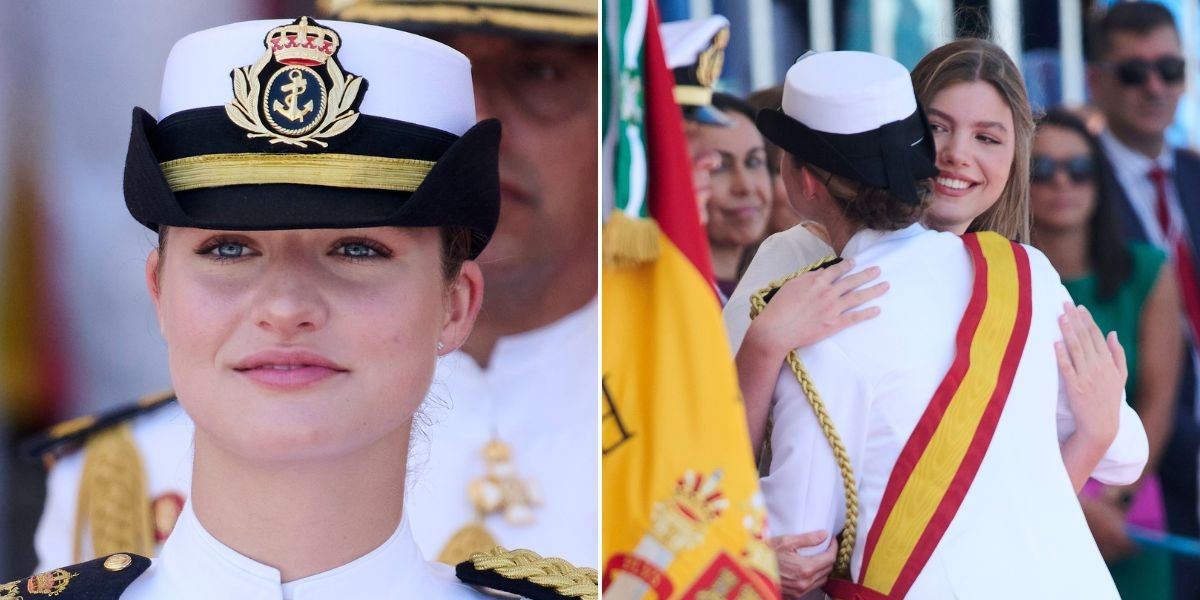
Crown Princess Leonor, heir presumptive to the Spanish throne, has taken on the weighty responsibility of preparing to one day reign as queen. Following her graduation from UWC Atlantic College in Wales in 2023, she entered Spain’s military academies — a decision deeply rooted in tradition. Like her father, King Felipe VI, Leonor’s training encompasses all three branches of the Spanish Armed Forces: the Army, Navy, and Air Force.
Currently enrolled in the General Military Academy in Zaragoza, Leonor’s schedule is far from ceremonial. Her daily life consists of drills, leadership exercises, tactical studies, and exposure to the physical and mental challenges of military life. The discipline instilled during this training is intended to strengthen her authority as the future commander-in-chief of Spain’s armed forces.
Royal watchers note that Leonor has embraced this role with maturity beyond her years. At just 19, she has been praised for her dedication, humility, and composure during public ceremonies. Her image is being carefully cultivated to resonate with Spain’s citizens, many of whom see her as a symbol of continuity in a time of political fragmentation.
Sofía: A Civilian Choice
In contrast, her younger sister, Infanta Sofía, has chosen a different path. Though she does not carry the burden of direct succession, her life is equally scrutinized as a member of the royal family. After completing her studies at UWC Atlantic College alongside Leonor, Sofía has opted against military training.
Instead, beginning in September 2025, she will pursue a degree in Politics and International Relations at Forward College, under the University of London. The program is distinctive: students divide their studies across major European capitals. For Sofía, this will mean spending her first year in Lisbon, her second in Paris, and her final year in Berlin.
The three-year program is designed not only to provide academic knowledge but also to immerse students in different cultural and political environments. By living and studying in diverse European contexts, Sofía will gain firsthand experience of the challenges and opportunities facing the continent — from governance and diplomacy to migration and climate change.
Her choice reflects a broader trend among younger royals in Europe who are increasingly pursuing academic and professional paths outside of strictly traditional royal duties. Analysts suggest that Sofía’s decision may allow her to carve out a role as a global-minded representative of Spain, one who can bridge the monarchy with contemporary issues that matter to younger generations.
A Symbolic Divergence
The contrast between the sisters is striking but not divisive. Palace insiders describe Leonor and Sofía as extremely close, with a relationship rooted in mutual respect and support. While Leonor shoulders the heavy responsibility of monarchy, Sofía is carving out a life that offers more freedom.
Experts argue that this divergence is actually beneficial for the monarchy. “It sends a powerful message,” said historian María Ángeles Pérez. “Leonor’s training represents duty and continuity, while Sofía’s academic choice reflects modernity and openness. Together, they embody a balanced vision of what the Spanish crown can mean in the 21st century.”
Public Reaction
The Spanish public has largely embraced the sisters’ different trajectories. Leonor has earned admiration for her commitment to military service, which many view as an essential preparation for leadership. Meanwhile, Sofía has been applauded for her independence and for choosing a path that emphasizes intellectual development and international perspective.
On social media, young Spaniards in particular have expressed excitement about Sofía’s studies. Many see her as a relatable figure who, despite her royal status, is pursuing a path similar to that of many students abroad. Others note that her chosen field — politics and international relations — could equip her to play an important supporting role in Spain’s diplomatic relations.
The Monarchy in Transition
The Spanish monarchy has faced its share of challenges in recent decades, from political debates over its relevance to scandals involving former King Juan Carlos. Against this backdrop, the new generation of royals is seen as an opportunity for renewal.
King Felipe VI has worked hard to restore credibility to the crown through transparency and commitment to service. His daughters, with their divergent paths, may offer an even stronger narrative of resilience and adaptability. Leonor’s military service underscores stability and authority, while Sofía’s studies suggest intellectual curiosity and international engagement.
Looking Ahead
In the coming years, Spain will watch closely as both sisters continue their journeys. Leonor still faces years of military training before she transitions to university-level studies, possibly in law or political science, to round out her preparation for the throne. Sofía, on the other hand, will be navigating life as a university student, far from the royal palace, immersed in the realities of European youth.
Though their futures are distinct, both paths converge in one key respect: service to Spain. Whether through the discipline of the military or the insight gained from political studies, both sisters are preparing to represent their country in ways that reflect their personalities and strengths.
Conclusion
The story of Princess Leonor and Infanta Sofía is one of unity in difference. While one marches in step with soldiers and prepares for the weight of a crown, the other engages in debate and diplomacy across Europe. Together, they are reshaping the public’s perception of royalty — not as a rigid institution, but as a living, evolving entity that can adapt to the times.
For Spain, this duality could prove to be its greatest asset. A monarchy that blends tradition with modernity, discipline with intellectual freedom, may be exactly what the nation needs in an era defined by change.